AI | Future of Work | Strategy
The Org Chart is Obsolete: Principles of AI-Augmented Organizational Design

AI is rewriting organizational design. As a result, the static org chart is obsolete. The winning model shifts from hierarchy to holarchy: dynamic, AI-augmented networks organized by competence, not authority. Organizations that close the gap this decade will design roles as human-AI partnerships, flatten information flow, and deliver measurable EBIT impact.
The core mandate: Key takeaways
The org chart is obsolete
The static symbol of fixed hierarchy is no longer the competitive model. Market leaders are building dynamic, AI-augmented networks instead.
Shift to holarchy
Move from vertical control (hierarchy) to horizontal alignment (holarchy), powered by a data transparency layer that every team can access in real time.
Design for augmentation
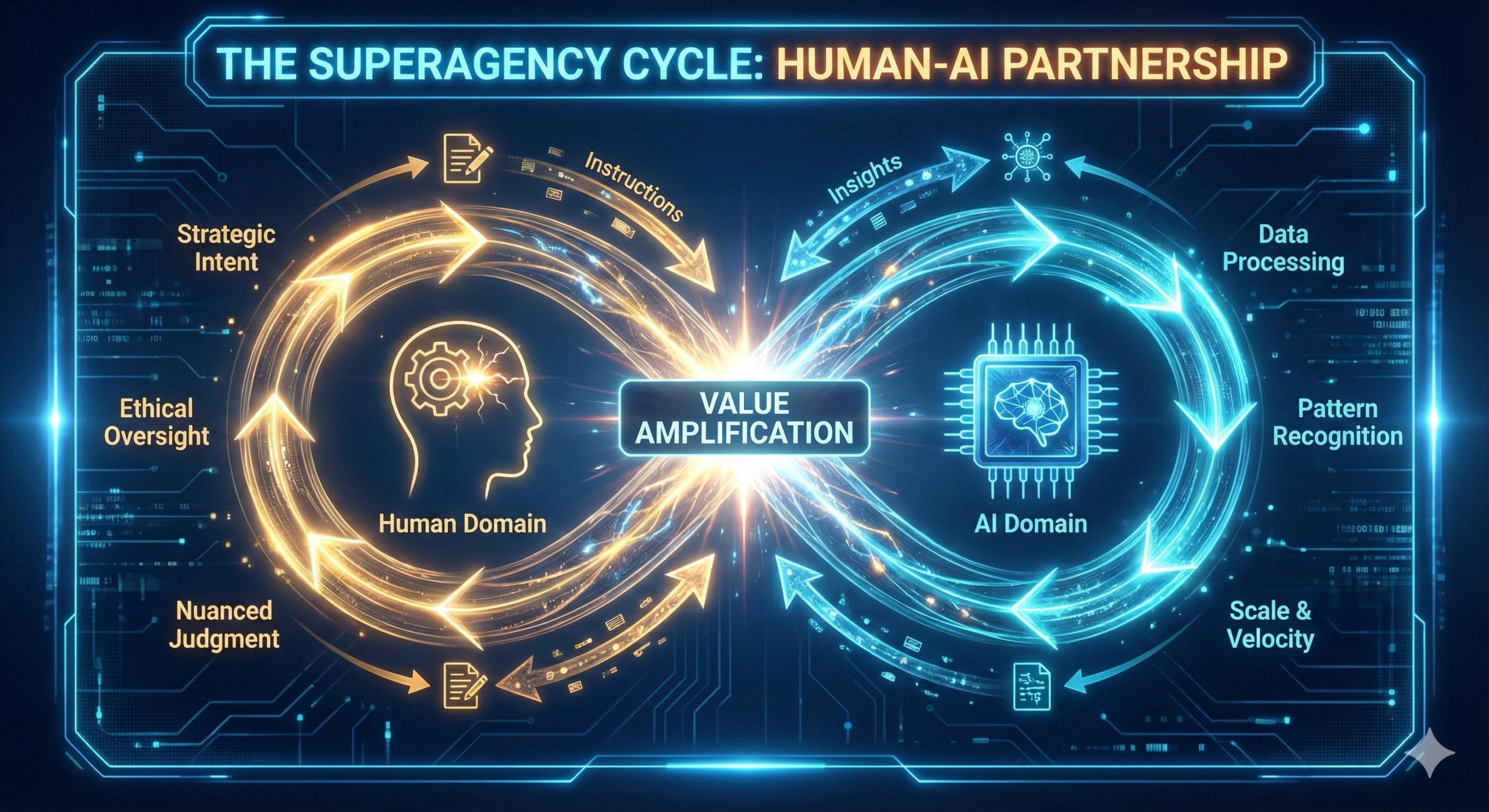
Do not automate jobs. Amplify talent. Structure roles as human-AI partnerships, where human judgment and strategic oversight remain the scarce, high-leverage resource.
The static org chart is obsolete. Agentic AI is forcing the redesign.
This static symbol of fixed hierarchy has become a liability. Because AI shifts the axis of power, speed, and talent, the organizations still clinging to vertical control are already falling behind. McKinsey’s 2025 State of AI report confirms the structural divide: high performers are 2.8x more likely to fundamentally redesign workflows than their peers, and 3.6x more likely to use AI for transformative business change rather than incremental improvements. So the question is no longer “How do we fit AI into our existing structure?” It’s “What structure can only exist because of AI?”
I’ve seen this divide up close. While most teams focus on finding the right tool, the organizations that actually move are the ones whose leaders stopped waiting for a perfect strategy and started redesigning the structure around the data they already had. In other words, they stopped asking “what AI tool should we buy?” and started asking “what do we need to build?”
“We are shifting from the era of ‘Generative’ to ‘Agentic’ AI. The goal is no longer just to generate content, but to execute workflows. Agents allow us to move from asking AI to ‘write this’ to asking AI to ‘do this,’ bridging the gap between insight and action.”
Why 61% never see the return
While 88% of organizations now use AI, only 39% report EBIT impact at the enterprise level (McKinsey State of AI, 2025). The difference is not the tool. Instead, the winners are dismantling silos, because AI eliminates information intermediaries and transforms static job roles into dynamic skill portfolios. As a result, the conversation moves past efficiency gains toward a new organizational blueprint built for real-time data flow and augmentation-first design. That is the structural gap this article addresses.
Strategic alignment: The networked operating model
The systemic foundation
The AI-augmented organizational design blueprint starts from one operational reality: in an agentic AI world, the speed of decision-making (flow) matters more than the verification of authority (control). Furthermore, every layer of approval that slows down that flow is now a measurable competitive liability.
(Where Network Velocity is information transparency and Hierarchical Control is vertical latency)
Information latency
Problem: Critical data gets stuck in middle-management layers.
Data transparency layer
Solution: Give every node instant access to decision-quality data.
Implication
Shift from “permission-based” workflows to “audit-based” autonomous workflows.
Talent rigidity
Problem: Job descriptions are static, but market needs are fluid.
Talent liquidity
Solution: Skills flow to the highest-value problems instantly.
Implication
HR must stop managing “roles” and start managing “skill portfolios.”
From hierarchy to holarchy: The AI-augmented model
This shift rewrites the flow of information and decision rights. In the pre-AI era, information flowed vertically, filtered and interpreted by layers of management. AI creates a shared, real-time data foundation, so every functional team gets immediate access to contextualized, actionable insights. As a result, the move from rigid hierarchies (organized by control) to holarchies — dynamic networks organized by competence and goal-alignment — becomes not a choice, but an inevitability.
In every organization I’ve worked with, the bottleneck was never the data. It was the layers sitting between the data and the people who needed it. Yet removing those layers is not a technology problem. It’s a design decision, and that is exactly where most AI transformations stall.
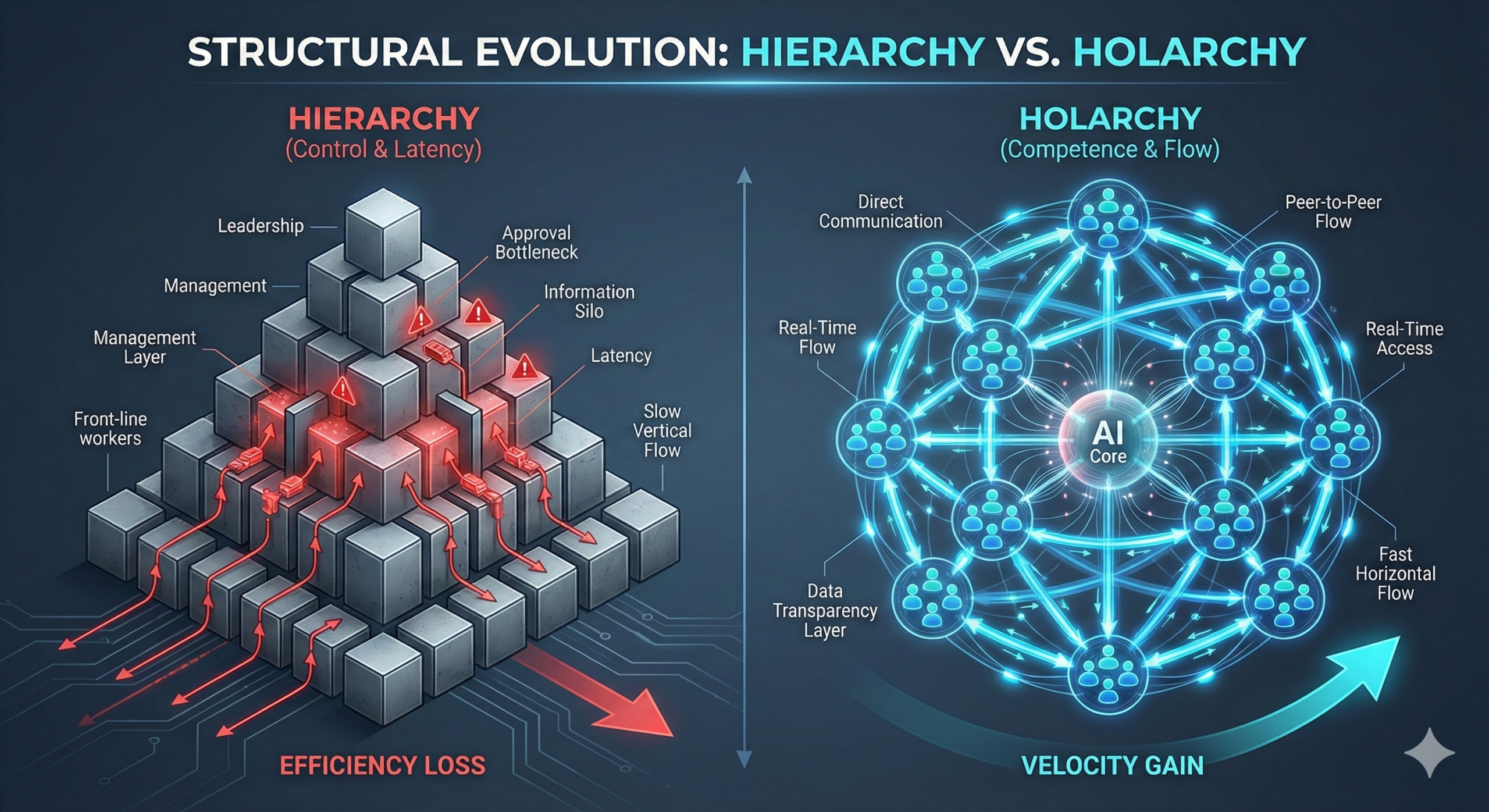
The operating model: From approval chains to shared context
Think of it like a franchise model. The central AI ensures every unit, whether a team, an individual, or an AI agent, operates from the same real-time data. Because of that shared foundation, local decisions happen fast, without waiting for top-down approval. Moreover, standards are maintained not by permission, but by shared context and audit. In other words, trust becomes structural, not interpersonal.
The design framework: 4 principles of augmentation
P1: THE SUPERAGENCY PRINCIPLE
Augmentation-first design: Do not design for job replacement. Instead, design for talent amplification through agents. Structure roles as human-AI partnerships, where autonomous agents execute routine steps and humans provide strategic oversight. Although this requires a mindset shift, it is the only model that scales.
Systemic mandate: As a result, human capital is freed for complex problem-solving and innovation that agents cannot replicate.
P2: THE LATENCY PRINCIPLE
Flatten the flow: Use AI to automate coordination and reporting. Then shrink the middle management layer from an information conduit into a strategic coaching layer, so decisions reach the front line without delay.
Systemic mandate: The AI brain provides common operational context, which eliminates the “latency” that stifles agility.
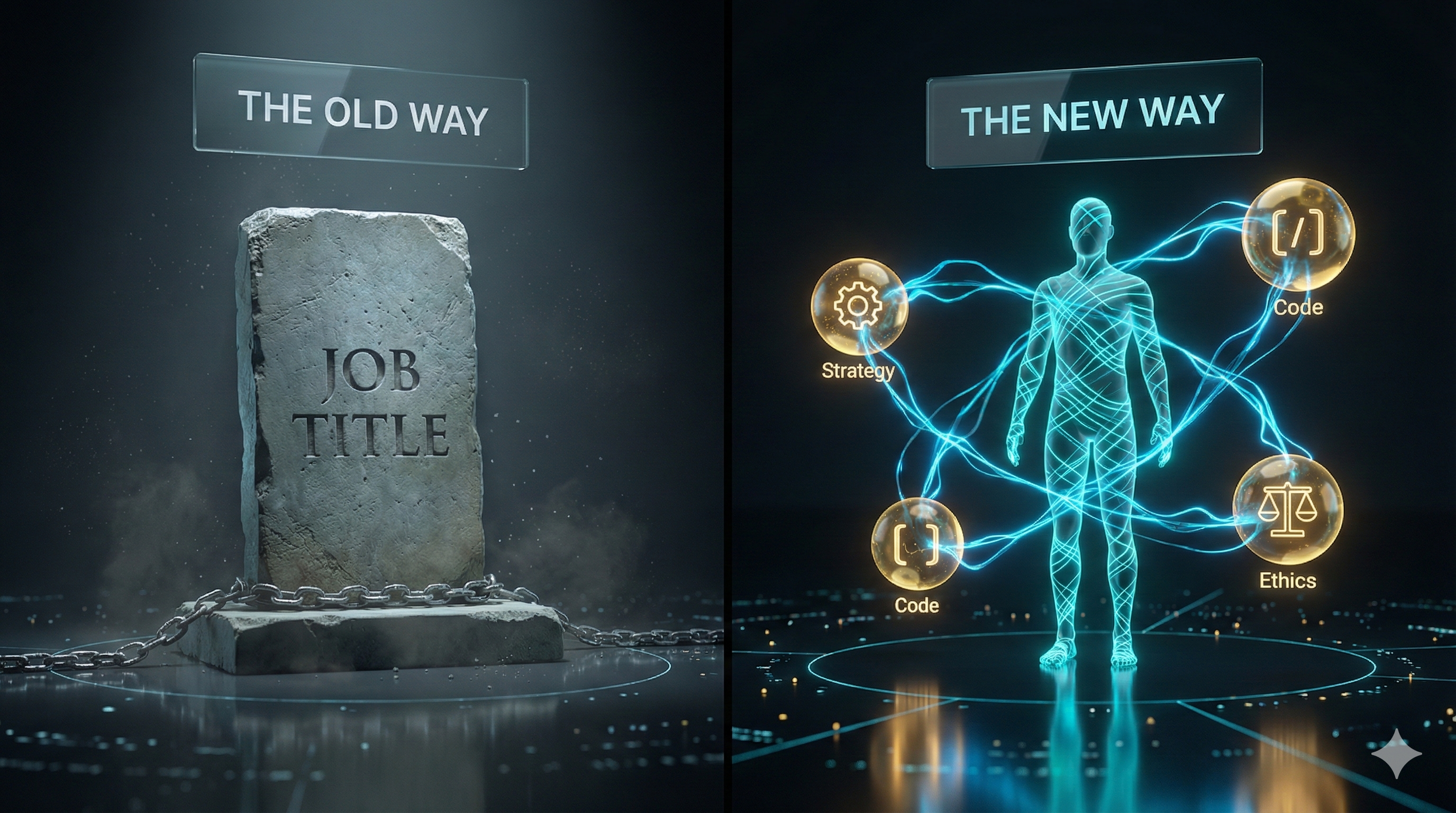
P3: THE TALENT LIQUIDITY MODEL
Skill portfolio: Traditional job titles shackle talent, because they fix people to roles rather than problems. Structure is now built around a dynamic skill inventory, where AI tools continuously assess gaps and recommend personalized upskilling paths. For instance, instead of hiring a “Data Analyst,” you build a team that holds the skill, regardless of title.
Systemic mandate: The workforce becomes fluid and adaptable, so it responds to market demands rather than org chart constraints.
P4: THE TRUST ARCHITECTURE
Embed human-in-the-loop guardians: Inaccuracy is the number one AI risk, with a 30% incidence rate (McKinsey State of AI, 2025). So embed AI governance roles directly within business units, not just IT, where the decisions actually happen. Otherwise, you are auditing outcomes instead of shaping them.
Systemic mandate: Ethical and strategic oversight is present at the point of decision, not added as an afterthought from a central compliance team.
The principles in practice: Two models that make it real
Strategic checkpoint: Avoid “automating the mess”
Applying AI to existing, inefficient processes accelerates bad habits. So attaching a jet engine to a horse-drawn carriage produces structural failure, not speed.
Map your key value streams first. Identify the hand-offs and latency points. Redesign the flow to eliminate friction, then apply AI agents to automate the newly streamlined connections.
The leadership mandate: Activation and mindset
Phase I: Activation mandates
-
Mandate the latency audit: Direct all functional heads to map their top three value streams. Identify hand-offs. Then apply AI agents to accelerate the streamlined flow, not to automate existing friction.
-
Establish the talent liquidity metric: Transition HR away from tracking static “job titles” toward tracking “skill gaps” and “skill velocity,” the speed at which skills are acquired across the organization. Unless you measure this, you are flying blind on your most critical asset.
-
Appoint the governance council: Create a cross-functional body (IT, Legal, Ops, Product) to define ethical boundaries and strategic oversight protocols before AI is deployed at scale. Without this, inaccuracy risk compounds at every layer of the organization.
Phase II: The mindset shift
Old mindset (hierarchy)
“I am the information broker: my value comes from controlling the flow of data.”
New mindset (holarchy)
“I am the context architect: my value comes from setting the shared, real-time context for AI squads.”
Implication: Focus on designing the AI data layer and ensuring its integrity, not on filtering reports. When the data layer is clean, trust follows automatically.
Old mindset (hierarchy)
“My primary role is risk mitigation: control and compliance minimize deviation.”
New mindset (holarchy)
“My primary role is talent amplification: coaching and oversight maximize strategic foresight and human-AI partnership.”
Implication: Invest in AI ethicists and prompt engineers to coach teams, not just auditors to check their work. Since the threat is internal, so is the solution.
Old mindset (hierarchy)
“We need stability: the org chart is a fixed machine built for endurance.”
New mindset (holarchy)
“We need adaptability: the organization is a learning system built for continuous, market-driven reconfiguration.”
Implication: Team structures and skill requirements are dynamic, changing based on market signals captured by AI. Therefore, the annual org chart review must become a continuous, data-driven process.
The ecosystem evolution
Moving from a rigid hierarchy to an adaptive holarchy is not an upgrade. In fact, it changes how decisions get made, how talent flows, and how fast the organization learns. When you build on these four principles, you move from a fixed machine to a living system. That is the new competitive standard: human creativity as the scarce, high-leverage resource, continuously amplified by an AI backbone. Furthermore, the organizations that install this now will be the ones setting the terms of competition in their markets three years from now.
ACCESS THE EXECUTIVE TOOLKIT
Three resources to start implementing AI-driven organizational design this week.
- View Deck
The Terminal Deck
The strategic briefing on the 4 design principles: from hierarchy to holarchy.
- View Scorecard
Talent Liquidity Scorecard
A diagnostic to identify your current organizational state and prioritize your shift.
- Launch AI Tool
Legacy-to-Liquidity Decoder
Turn static job descriptions into AI-ready skill portfolios. Discover your agentic stack for automation.