Agility | AI | Leadership | Strategy
Scrum Master to Cognitive Strategist: The 2026 Evolution Blueprint

The Scrum Master evolution into the Cognitive Strategist is the non-negotiable shift required to thrive in the Agentic AI Wave. When McKinsey research confirms that AI Agents are poised to automate up to 70% of routine process work, the role must shift exclusively to high-latency human judgment (System 2) and Workflow Orchestration. This blueprint mandates a transition from “process enforcer” to Human-in-the-Loop Governor and Organizational Neuro-Coach, so that human strategic capacity scales alongside AI computational velocity.
The core mandate: Key takeaways
The Liquidation Fallacy
Cutting the Scrum Master role because AI automates “process” is a strategic miscalculation. This move liquidates the very System 2 capacity required precisely when validation of AI outputs is most critical.
Neuro-Coaching over compliance
The new mandate is managing Threat Response and Cognitive Load. Indeed, psychological safety is now a measurable efficiency metric, not merely a soft skill.
The “Human-in-the-Loop” Governor
Inaccuracy is now the #1 risk. As a result, the Cognitive Strategist is the firewall who defines exactly when human judgment must validate Agent outputs.
The Liquidation Fallacy: When the C-Suite looks to cut overhead, the Scrum Master is often the first target for elimination. This is a dangerous, short-sighted calculation. McKinsey research confirms that the “combination of AI solutions alongside human judgment” creates real “Hybrid Intelligence” capabilities, with the potential to automate up to 70% of work activities.
The Scrum Master evolution: from process enforcer to Cognitive Strategist
Stop Policing the Process. Start Orchestrating the Agents. While AI Agents can now plan and execute workflows, they bring a new risk: Inaccuracy. For example, McKinsey’s The State of AI in 2025 confirms that 30% of organizations have already experienced negative consequences due to inaccuracy. The position must immediately pivot to The Cognitive Strategist. This leader is responsible not for administrative mechanics, but for “Human-in-the-Loop” validation and orchestrating the hand-offs between autonomous agents and human experts — a process the Phoenix Protocol architects at the enterprise level.
The visualization below maps this critical evolution: the fusion of organic System 2 judgment with Agentic AI to produce the three pillars of the new mandate.
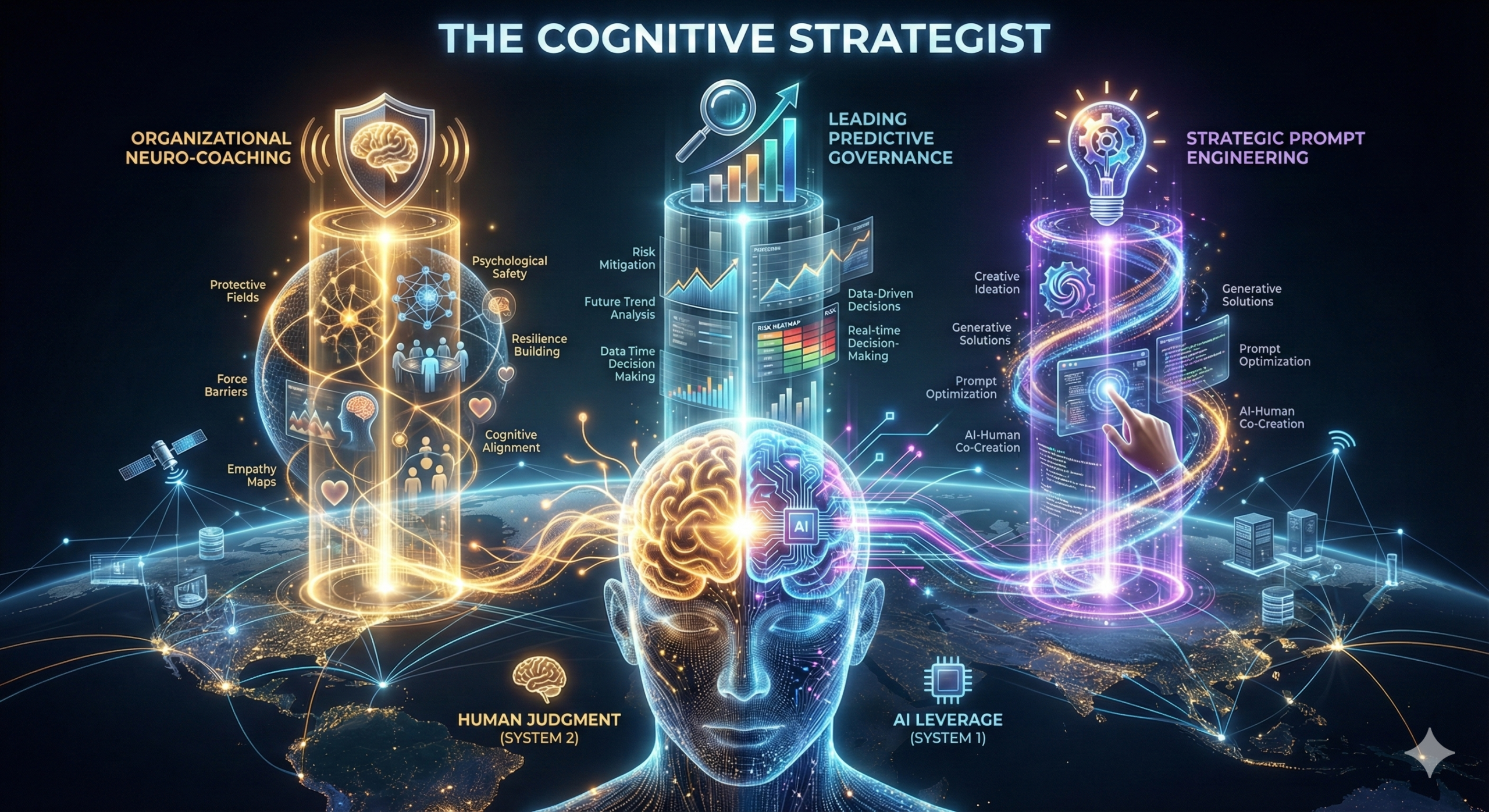
“AI is rarely a stand-alone solution. Instead, companies capture value when they effectively enable employees with real-world domain experience to interact with AI solutions at the right points. The combination of AI solutions alongside human judgment and expertise is what creates real ‘hybrid intelligence’.”
Strategic alignment: The Hybrid Intelligence Model
The Value Equation
The Cognitive Strategist Blueprint adapts Daniel Kahneman’s Thinking, Fast and Slow framework to the AI age. As the marginal cost of intelligence drops toward zero for rapid “System 1” automation, the economic value of deliberate “System 2” Human Insight is skyrocketing.
(Note: Where System 2 is Human Judgment and System 1 is AI Automation)
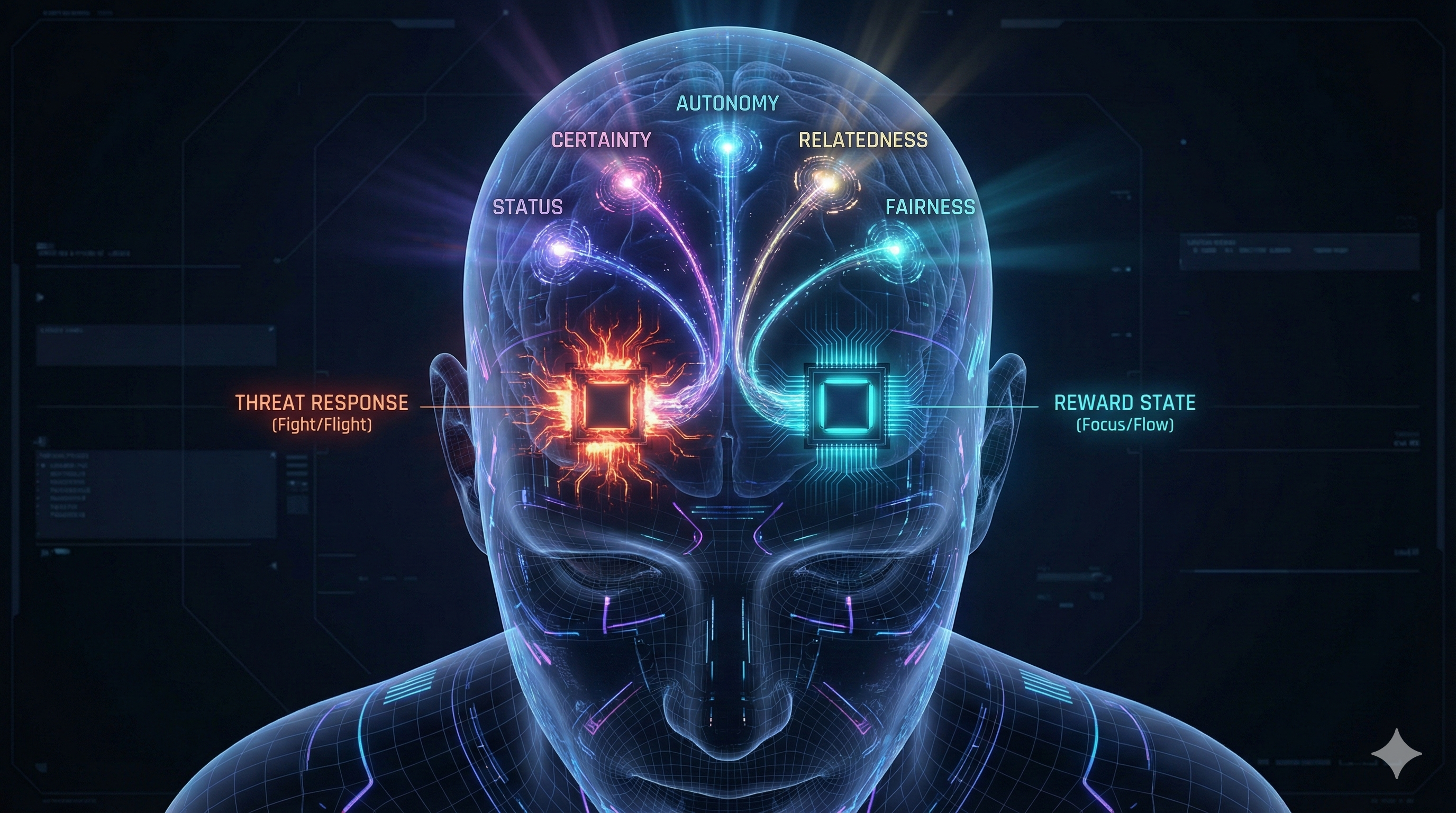
Cognitive Overload
Problem: Teams are drowning in information velocity.
Neuro-Coaching
Solution: Neuro-Coaching reduces threat response, restoring focus and flow.
Implication
The Cognitive Strategist is the guardian of the team’s cognitive bandwidth.
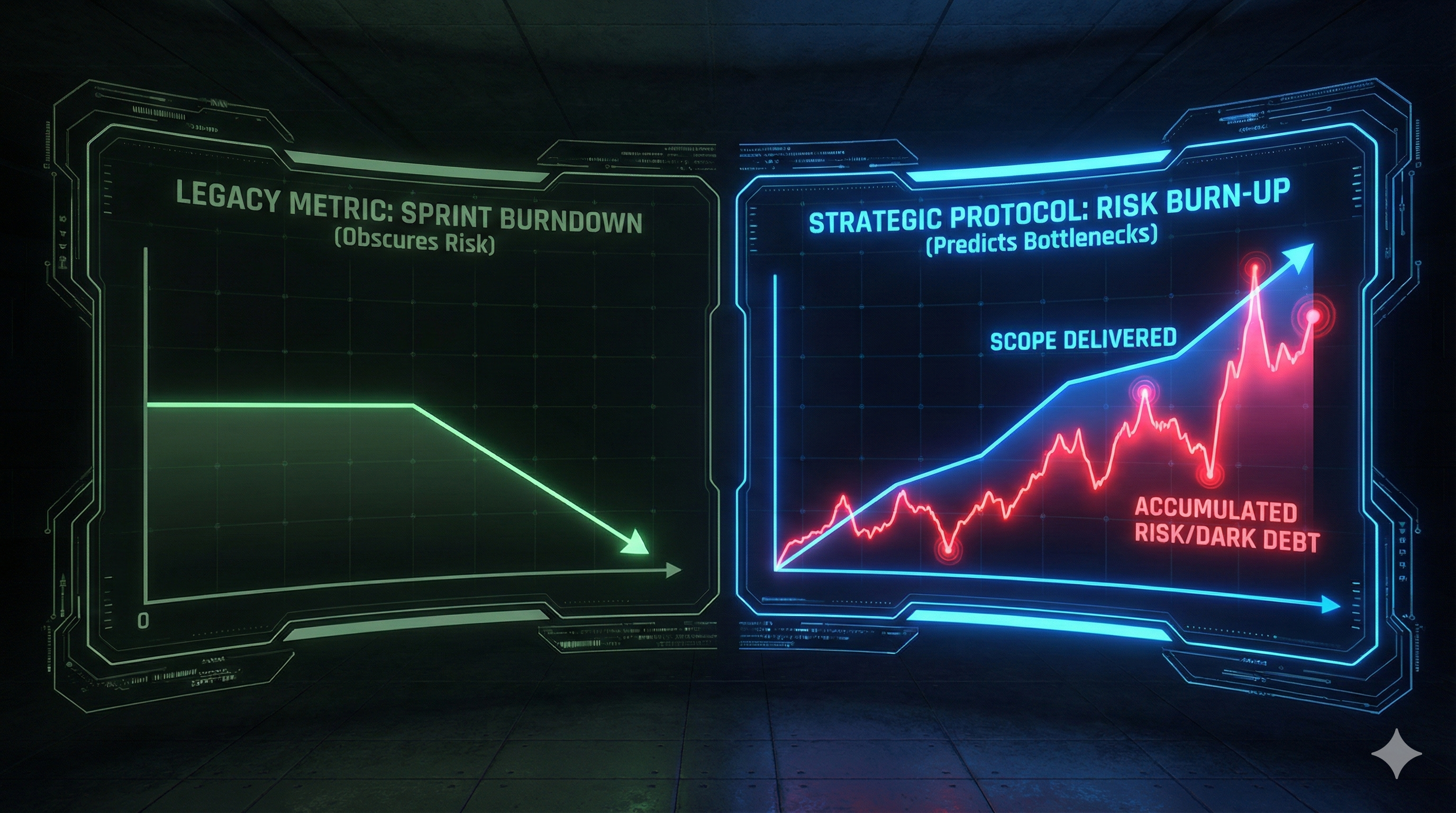
Unpredictable Delivery
Problem: Traditional velocity metrics mask actual risk.
Predictive Governance
Solution: Predictive Governance uses AI data to forecast bottlenecks before they occur.
Implication
The Cognitive Strategist shifts from “Reporting the Past” to “Securing the Future.”
The Cognitive Strategist Framework
Principle 1: Organizational Neuro-Coaching
Objective: To diagnose and mitigate the team’s psychological “Threat Response” (SCARF model) which blocks innovation.
Playbook Action: While synchronizing on value delivery, explicitly diagnose ‘Cognitive Friction’. Use the Daily Scrum to identify where uncertainty or silence is blocking flow, intervening to restore the psychological safety required for complex problem solving.
Systemic Mandate: Tie the Cognitive Strategist’s impact metrics to the team’s Silence Index, rather than solely velocity.
Principle 2: Leading Predictive Governance
Objective: To transition from a lagging-indicator reporter to a leading-indicator risk governor.
Playbook Action: Use AI analysis of repository data to identify “dark debt” and high-risk code patterns. Then translate this technical probability into executive business risk.
Systemic Mandate: The Cognitive Strategist is authorized to halt a release train based on predictive risk models.
Principle 3: Agentic Workflow Orchestration
Objective: To transition from “managing people” to “managing the Human-Agent handoff.”
Playbook Action: The Cognitive Strategist redesigns the value stream, assigning low-latency tasks to AI Agents while explicitly reserving high-stakes decision points for human “System 2” intervention. As a result, the organization captures speed without sacrificing accuracy.
Systemic Mandate: The Cognitive Strategist is the architect of workflow redesign, ensuring Agents run correctly, rather than solely maximizing speed.

Forensic report: The cost of liquidating human judgment
The data below is not theoretical. When organizations treat the human judgment layer as overhead rather than infrastructure, the consequences show up in customer outcomes, delivery quality, and ultimately in the CEO’s own admission. The 18th Annual State of Agile Report (2025) — the first edition in its history to focus entirely on AI — confirms that the market is moving toward professionals who improve system health, not merely protect ritual quality. The two cases below show what happens when organizations get this decision right, and when they get it catastrophically wrong.
The evidence: human judgment as competitive infrastructure
The decision: Between 2022 and 2024, Klarna eliminated approximately 700 positions — primarily in customer service — replacing them with an AI assistant built with OpenAI. The logic was pure efficiency: reduce headcount, cut cost, scale with AI. The same cost-cutting logic is now driving the elimination of Scrum Masters across the enterprise. The outcome follows the same pattern.
The outcome was a surge in customer complaints, declining satisfaction scores, and AI responses customers described as generic and insufficiently nuanced when handling complex issues. In 2025, CEO Sebastian Siemiatkowski reversed course and began rehiring human staff.
“We went too far. Cost, unfortunately, seems to have been a too predominant evaluation factor.” — Sebastian Siemiatkowski, CEO, Klarna. Entrepreneur, 2025
The business cost:
Service quality erosion + full strategic reversalThe decision: In 2015, ING Bank restructured 3,500 employees into self-organizing squads and embedded agile coaches — the organizational equivalent of the Cognitive Strategist — as the primary human intelligence layer responsible for mindset, flow, and psychological safety.
- Net results: Netherlands division increased 54% from 2015 to 2017. (Harvard Business School)
- NPS: Jumped from −30 to +30 within 12 months of transformation.
- Employee engagement: Reached 93% inside the transformed tribes.
The business upside:
54% net results growth in 24 monthsThe leadership mandate: Investing in Human Intelligence
Required behaviors
-
Invest the Time Dividend: Also, the capacity liberated by AI automation should be reinvested in high-value coaching and learning, not filling the void with more backlog tasks.
-
Fund the Coach: Align compensation with strategic value. The Cognitive Strategist is a senior human-systems architect, not a junior process administrator.
-
Demand Forecasting: Don’t rely solely on “Sprint Burndown” charts. Ask for “Risk Burn-up” for the next quarter.
Systemic risks
-
The Liquidation Fallacy: Eliminating Scrum Masters to save costs removes the only people capable of managing AI complexity. The Scrum Master evolution is not optional — it is the enterprise’s human firewall.
-
The Utilization Mismatch: Reducing a Systems Coach to a logistics coordinator is ROI-negative. Automate the mechanics to liberate the human for complex conflict resolution and facilitation.
-
Ignoring Threat Response: When organizations ignore the psychological toll of AI adoption, burnout follows. The Cognitive Strategist serves as the organizational firewall against this outcome.
Liberate Your Leadership
The agility of the enterprise in the coming years will be less about the tools adopted and more about the quality of the human leadership liberated. When the organization evolves the process-focused Scrum Master into the human-focused Cognitive Strategist, it is not merely preserving a role. It is building a strategic asset that can manage psychological safety, govern predictive risk, and orchestrate Hybrid Intelligence.
ACCESS THE EXECUTIVE TOOLKIT
Access three powerful resources to immediately implement The Cognitive Strategist mandate.
The Terminal Deck
The Strategic Briefing on the Evolution from Scrum Master to Cognitive Strategist.
Predictive Governance Scorecard
A template for measuring and communicating organizational risk vs. probability.
AI Retrospective Designer
The specialized tool required to efficiently design a customized, full 4Cs Framework structure.