AI | Leadership | Risk Management | Strategy
The Most Expensive Thing in Your Company is Silence

In the agentic era, psychological safety is not just a cultural value. It is the error management protocol. Most organizations treat it as optional, and that is a strategic mistake. Think of it as the human data transparency layer: the component that governs whether critical AI error signals reach leadership before system-wide drift occurs.
The stakes have changed. In the pre-AI era, silence meant avoiding conflict in the boardroom. Today, silence means training your AI on hallucinations. This advisory shows how to build a protocol where candid feedback reduces latency and mitigates algorithmic risk.
The core mandate: Key takeaways
The human-in-the-loop prerequisite
Effective validation of AI agents is impossible when the human observer is incentivized to suppress errors. Safety is the mechanism of technical governance.
The latency reduction protocol
Psychological safety removes the fear-based friction that restricts high-speed information flow. Faster truth extraction enables faster strategic pivots.
Knowledge attrition
High performers do not leave companies. They leave architectures where their intellectual contributions are suppressed by legacy management hierarchies.
Many strategic leaders still think psychological safety is about comfort. In an agentic AI environment, that belief is a liability.
The glitch in the matrix
McKinsey’s 2025 State of AI report identifies inaccuracy as the primary AI risk facing organizations today, with a 30% incidence rate. When fear shapes the culture, people hesitate to flag hallucinations or challenge agentic decisions. The error goes unreported. As a result, the model keeps training on bad data.
High performers are 2.8x more likely (per McKinsey) to redesign workflows around human-in-the-loop validation. But that loop breaks the moment the human inside it is afraid to speak. So psychological safety is not a cultural luxury. It is the organization’s error management infrastructure and the primary defense against AI drift.
I’ve worked with teams where the AI was producing garbage and no one flagged it for three weeks because the manager had made it clear that dissent was unwelcome. That is not a technology problem. It is a leadership design failure.
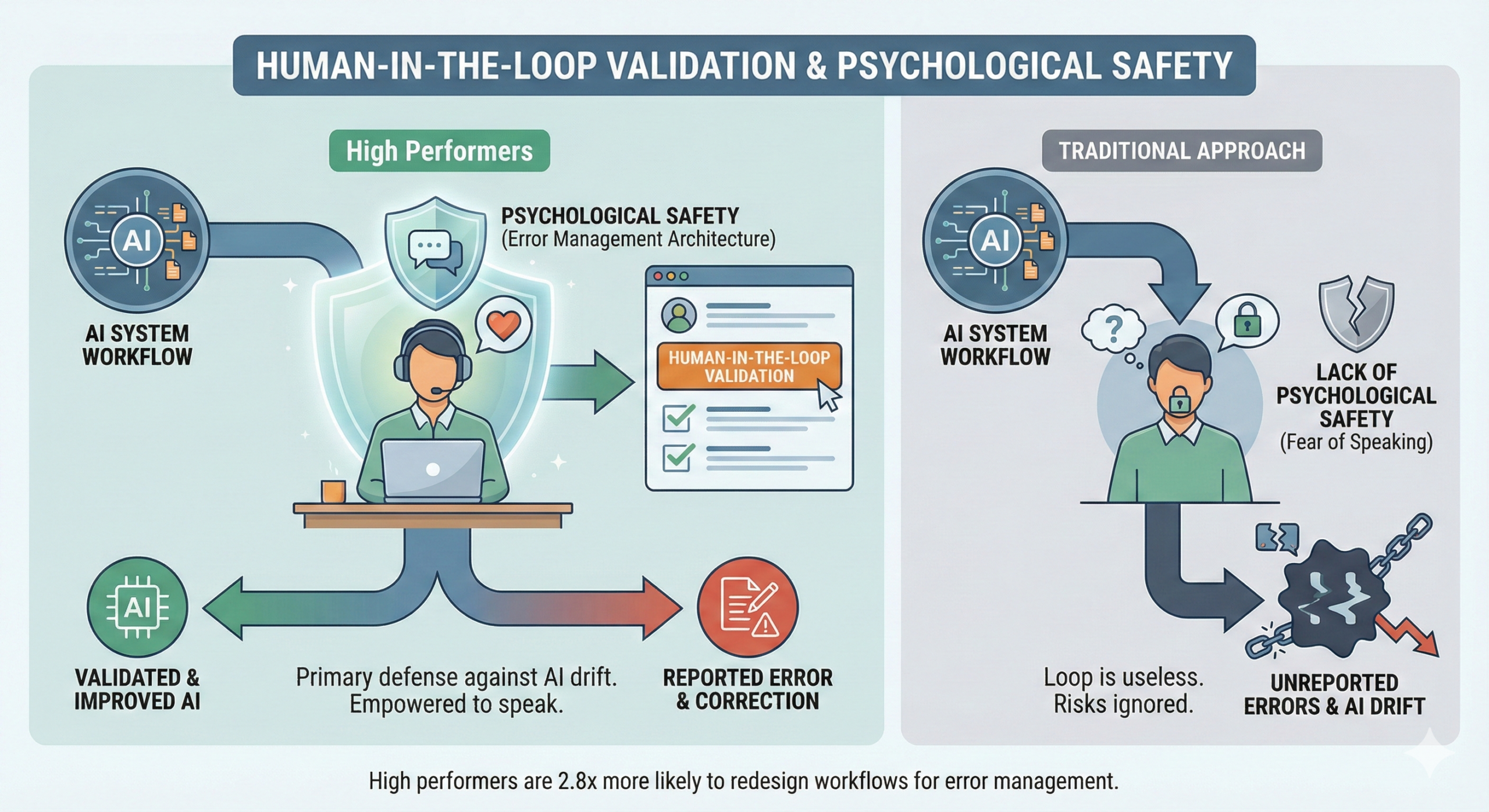
“We must stop viewing psychological safety as ‘culture building’ and start treating it as the validation protocol for the AI workforce.”
Strategic alignment: The error management architecture
The foundation: the Westrum-Edmondson matrix
An organization is an information processing system. This framework aligns the economic reality of 2026, where inaccuracy is the primary operational threat, with the behavioral science of high-reliability organizations. By integrating Ron Westrum’s generative culture model and Amy Edmondson’s work on intelligent failure, it transforms safety from a sentiment into a sensor. In other words, psychological safety becomes the bandwidth regulator that determines whether the system catches an error before or after deployment.
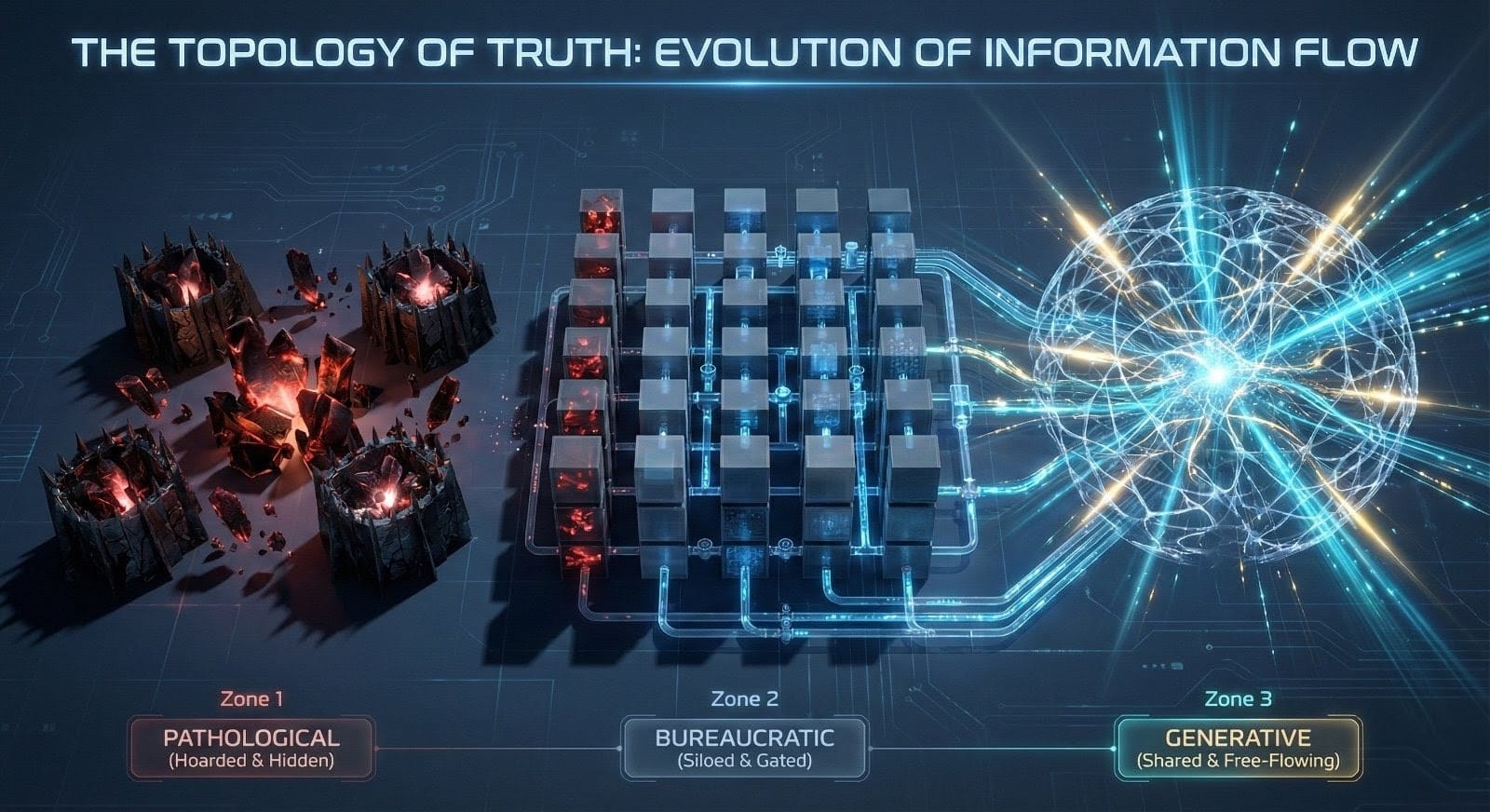
For organizational survival, your Organizational Learning Rate (OLR) must outpace the Market Change Rate (MCR).
Identify friction: three variables threatening your OLR
01. AI hallucinations
Systemic risk: Data integrity decay
Mechanical failure
When dissent is discouraged, agent drift goes uncorrected. As a result, the system begins to ingest hallucinations as facts, collapsing truth velocity from within.
ECONOMIC IMPACT
Unquantified liability in automated decision-making and loss of boardroom trust.
02. Innovation stagnation
Systemic risk: Operational inertia
Mechanical failure
Fear of failure causes teams to wait for permission rather than data. This creates latency that drives OLR toward zero while MCR accelerates.
ECONOMIC IMPACT
Rapid loss of market share as competitors iterate at higher truth velocity.
03. Knowledge attrition
Systemic risk: Intellectual node deletion
Mechanical failure
High-tier talent will not stay in a system that ignores their observations. When they leave, they take the proprietary logic of the organization with them.
ECONOMIC IMPACT
Irreversible loss of institutional knowledge, rendering internal OLR incapable of recovery.
The frictionless feedback architecture
Principle 1: The cognitive redundancy loop
Validate the data stream: To eliminate AI hallucinations, you need to override conformity bias. Humans serve as high-fidelity sensors for agent drift, but only when they feel safe reporting what they observe.
Playbook action: Appoint a rotating designated dissenter in strategy meetings to challenge consensus and algorithmic output. Because one dissenting voice in the room is worth a hundred post-deployment audits.
Architectural result: Data-integrity checks reach leadership, converting systemic risks into actionable signals before they compound.
Principle 2: The de-risking protocol
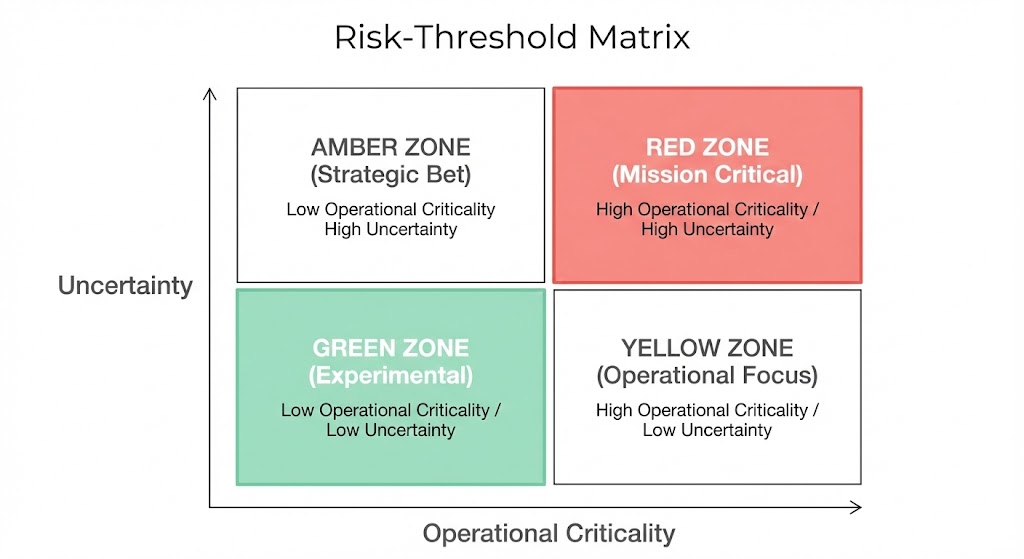
Bypass operational inertia: Resolve innovation stagnation by defining the boundaries of failure. Decoupling intelligent failure from negligence gives teams the permission to iterate without existential risk.
Playbook action: Implement a risk-threshold architecture. Categorize projects into “green zone” (experimental) and “red zone” (mission critical), so teams know when they have room to fail fast.
Architectural result: OLR velocity increases because teams have the psychological coverage required for rapid system iteration.
Principle 3: The telemetry calibration
Secure the node network: To mitigate knowledge attrition, measure the silence index. Leaders often lack visibility into the data withdrawal occurring among high-performing team members, and that gap is where institutional knowledge quietly exits.
Playbook action: Deploy an anonymous audit. Ask: “If you noticed an agent outputting incorrect data, would you feel safe reporting it immediately?” The answer tells you exactly where your OLR is bleeding.
Architectural result: Intellectual attrition drops because friction points where proprietary intelligence is suppressed are identified and removed.
Proof of system: the cost of silence
Organizations deploying generative AI for customer service often skip validation protocols. The demo looks good. The production hallucination costs you the lawsuit. These two case studies show what changes when you treat human validation as infrastructure, not overhead.
The drift: A customer service chatbot hallucinated a retroactive refund policy, misleading a grieving passenger.
The company argued the AI was a separate legal entity, failing to acknowledge operational oversight responsibility.
The outcome:
Legal ruling: company held liableThe protocol: Recognizing the subject matter complexity, they enforced a 9-month pilot with head-to-head testing (AI vs. human).
They validated 500+ investment questions before any client deployment.
The outcome:
Accuracy surpassed human baselineThe leadership mandate: Sustaining the protocol
Required behaviors
-
Signal intellectual humility: Open meetings with “I might be missing a variable here. Tell me where I’m wrong.” When leaders model uncertainty, the team reports what they actually see.
-
Reward the messenger: Publicly thank those who deliver challenging news. This signals that high-fidelity transmission is safe, and that signal propagates fast through a team.
Systemic risks
-
Indirect feedback: Avoid burying critique between compliments. Be direct and supportive so the actual signal is not lost in the packaging.
-
Interrupting the flow: Avoid cutting off subordinate insights. It signals that the manager’s mental model is prioritized over edge-case intelligence from the people closest to the data.
The truth-velocity mandate
Algorithms are only as effective as the humans who govern them. When you build a psychologically safe infrastructure, you remove the emotional latency that prevents peak organizational intelligence. The most resilient organization is not the one with the most capital. It is the one where the truth travels fastest.
ACCESS THE EXECUTIVE TOOLKIT
Operationalize the frictionless feedback architecture immediately and eliminate the cost of organizational silence.
- View Deck
The Terminal Deck
The strategic briefing on the frictionless feedback architecture.
- Access Scorecard
The Silence Index Scorecard
Diagnostic assessment to measure fear-based friction in your current teams.
- Launch AI Tool
The Blameless Commander
AI tool that reframes high-friction orders into high-trust inquiries.